
Table of Contents
As winter’s icy breath lingers over the vast Mongolian steppes, a quiet anticipation stirs in my family home. Tsagaan Sar, the “White Moon” festival, signifies more than just the start of a new year. It’s a time for tradition, strengthening family bonds, and personal reflection. As a Mongolian native, I have celebrated this festival every year for as long as I can remember, and no matter how much life changes, Tsagaan Sar remains a constant, reconnecting me to my roots and the generations that came before me.
The heart of Tsagaan Sar
Tsagaan Sar has evolved over centuries. Originally celebrated in autumn as Süün Sar (Milk Moon), the festival was moved to spring by Chinggis Khaan and renamed Tsagaan Sar. Historical accounts even mention Marco Polo observing Kublai Khan’s Tsagaan Sar celebrations, where the entire court dressed in white, exchanging gifts and feasting to welcome a prosperous year.
Today, family, respect, and hospitality remain at the heart of every celebration, with rituals that bring generations together.
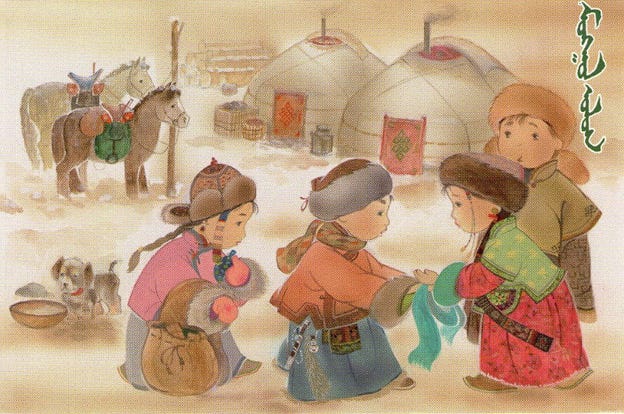
Tsagaan sar
Preparing for the Lunar New Year
In the weeks leading up to Tsagaan Sar, preparations take over every Mongolian home. There is an unspoken rule: everything must be in its best state — clean homes, fresh clothes, and a table brimming with symbolic foods. The kitchen becomes a hive of activity, as multiple generations gather to prepare buuz, Mongolia’s beloved steamed dumplings.
My hands still tingle from hours spent wielding the rolling pin, crafting over 2,000 dough circles. My wife and I join my grandmother, her siblings, their children, and their children in her warm kitchen, honoring our elders through the time-honored tradition of buuz preparation. The rhythmic motions, bursts of laughter, and the aroma of seasoned mutton filling the room — this is what Tsagaan Sar means to me.

Jamsranjav and mother at her eldest sister’s house, during bituun
The ul boov arrangement, a towering stack of hard pastries, takes center stage on our table. Each layer is interspersed with small cubes of dairy products and sweets, symbolizing abundance. As a sign of respect, guests touch the base of the ul boov with their right hand and take a piece of dairy before greeting the elders. Every act, no matter how small, carries deep meaning.

Ul boov arrangement at our Travel Designer Yuna’s home, tsagaan sar
Bituun: The Eve of Renewal
On Bituun (the last day of the old year), my family gathers for a quiet yet meaningful feast. The name Bituun signifies the end of the year’s cycle, a moonless night, and the tradition of consuming hearty, “complete” meals to ensure a prosperous year ahead.
A time-honored ritual follows as we step outside into the biting winter air. Three ice cubes are carefully placed on the hatavch, the threshold between the ger (a traditional Mongolian dwelling) and the outer world. It is believed that these will pave the way for Palden Lhamo (find more here), (the deity who rides a three-eyed horse that can travel three worlds in time it takes you to rub your fingers) ushering in the new year.
Bituun is also a night for games, where we gather to play horol (tile-based game), horse racing (sheep ankle bone game), alag melkhii (multicolored turtle) , and other traditional board games. It’s a time to pass down stories, lessons, and the spirit of community that defines Tsagaan Sar.
The First Day of Tsagaan Sar
On the first day of Tsagaan Sar, before dawn, the men of the household set out to greet the first sunrise of the new year. Together, we climb a nearby hill, inhaling the crisp morning air, and turn to face the east, silently welcoming the sun and the possibilities it brings for the year ahead. I remember my grandmother waking me up before the sky had even begun to lighten.
Upon returning home, we partake in the zolgokh (highest form of greeting gesture) ceremony, a ritual of deep respect. As the youngest, I extend my arms beneath the elbows of my elders, supporting them as they place their hands on my hands. We exchange well-wishes, reaffirming family ties. A blue or white khadag (a ceremonial silk scarf) is carefully draped over the hands of respected elders as a sign of reverence.
One distinct aspect of zolgokh is that husbands and wives do not greet each other this way. In marriage, they are considered one entity, symbolizing unity, and thus, they forgo the traditional greeting.
Another cherished custom is the exchange of khuurug, beautifully crafted snuff bottles made from materials like agate, coral, and nephrite. When offering a khuurug, the lid is slightly loosened, and when receiving one from an elder, it is held with both hands and respectfully touched to the forehead before being returned. These small acts of tradition reinforce the deep-seated values of honor and kinship in Mongolian culture.

CEO Uyanga greeting with her Teacher
The Heart of the Celebration
For me, Tsagaan Sar is more than a celebration — it is a reaffirmation of identity, a moment to step back from the modern rush of life and reconnect with family, heritage, and the values that have shaped me.
Each year, as I kneel before my elders, prepare dumplings in my grandmother’s kitchen, or step outside to place ice on the threshold, I am reminded that traditions are living, breathing connections that bind generations together.
In this new year, as the White Moon rises over the steppe, I welcome the future with open arms — rooted in the past, yet always looking forward.
By Jamsranjav Tuvshinsaikhan






Keep In Touch